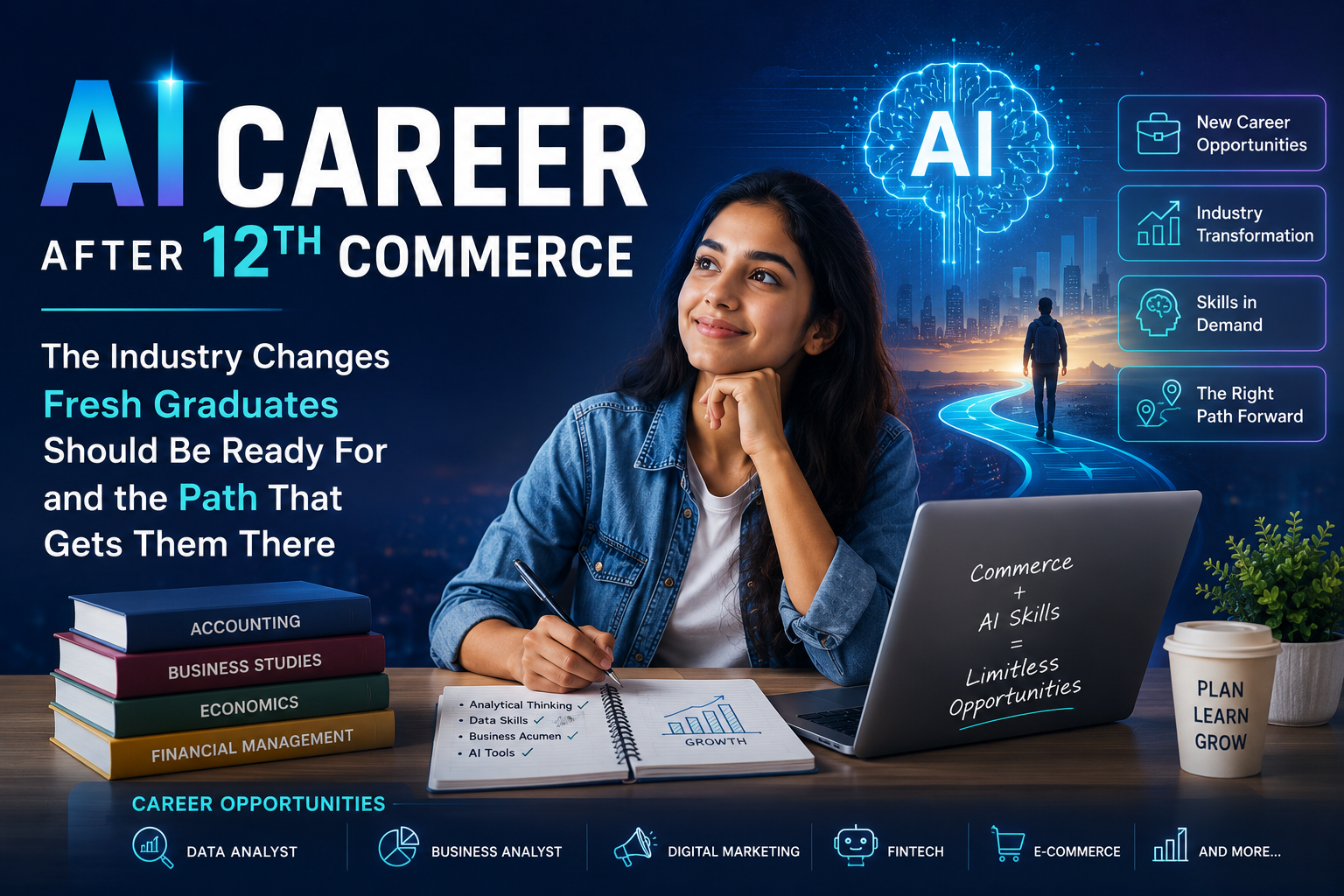
For a long time, the pathway after 12th commerce followed a predictable logic. You chose between CA, MBA, B.Com, or BBA. You studied hard, interned at an accounting firm or a bank, and entered a market that had a clear idea of what a commerce graduate was for. That clarity has not disappeared, but the definition underneath it has shifted, quietly and significantly, in the last three years.
The industries that absorb the majority of commerce graduates, banking, insurance, consulting, marketing, retail, and financial services, are not the same industries they were in 2021. They are now running on AI-assisted workflows, algorithmic decision-making, and data-driven operations. The professionals those industries need are not different people. They are the same commerce graduates, with one additional layer of competence that most curricula have not yet caught up to.
Here is the tension worth sitting with: the commerce stream has always trained students to understand systems, analyse numbers, and make decisions under uncertainty. Those are exactly the capacities that make AI for commerce students not just accessible but strategically powerful. The engineering assumption that AI belongs to the technical stream has kept commerce students out of a conversation they are actually well-positioned to lead.
Table of Contents
- 1. What the Industry Shift Actually Means Beneath the Headlines
- 2. What a Commerce Student in 2026 Is Actually Navigating
- 3. Who Should Move in This Direction and How to Know
- 4. A Practical Roadmap From Commerce Background to AI-Ready Professional
- 5. How Structured Education Closes the Gap
- 6. Career Roles: What Awaits the AI-Ready Commerce Graduate
- 7. Building the Skill Stack: What Specifically to Learn
- 8. The Non-Technical Student's Real Advantage
- 9. 2026–2030: The Direction This Is Moving
- 10. Clear Takeaways
- 11. Your Next Step Made Clear
- 12. Frequently Asked Questions
What the Industry Shift Actually Means Beneath the Headlines
The most important thing to understand about AI and the commerce job market is that the question is not "will AI take these jobs?" The question is "which part of this job will AI handle, and which part will remain human?" In every major commerce-adjacent sector, the answer follows a consistent pattern: AI is absorbing the routine analytical layer, and humans are being repositioned to the judgment, communication, and contextual interpretation layer. The students who understand this distinction are preparing for the right thing. The ones who do not are preparing to compete with a system that will outperform them on the very tasks they are training for.
Consequence: The Baseline Has Moved Without Announcement
A common experience across industries right now: HR teams describe candidates as "not quite what we need" without being able to articulate why. What they are observing, often without the language to name it, is the absence of AI literacy in candidates who are otherwise qualified. The market has moved the baseline without formally declaring it. The students who understand this are adapting. The ones waiting for an official announcement will wait a long time and arrive late.
Who Should Move in This Direction and How to Know
Who should pursue an AI-integrated commerce path right now?
Any student who plans to work in the organised economy within the next decade. The sectors that commerce
graduates have always entered, BFSI, consulting, marketing, retail, logistics, and media, are all actively
integrating AI into core operations. A student who graduates with both domain knowledge and AI fluency
enters these sectors with a profile that stands out in an environment where most candidates have one or the
other.
Who should not rush into this direction?
A student who is drawn to AI primarily because it sounds impressive, without any genuine interest in either
the commerce foundation or the applied learning, is likely to build surface-level competence that does not
hold up. AI without coding is genuinely accessible, but it still requires deliberate engagement. Students
who are not willing to apply AI tools to real problems will collect credentials without building capability.
When is the right time?
Now specifically, at the point of choosing a degree programme after 12th. The most effective integration of
AI and commerce learning happens within a structured degree environment, not as an afterthought in the final
year or a standalone certificate taken post-graduation. Students who choose programmes with AI integration
built in from the outset develop a compounded competence that students who add AI later rarely match.
What happens if this is ignored?
The cost is cumulative and invisible for the first two years. A commerce graduate without AI literacy will
find entry-level roles, because the baseline is not yet universally enforced. But they will find that the
promotion trajectory, the salary differential, and the quality of opportunities open to them diverge
noticeably from those of peers who built this layer. By year three, the gap is clear. By year five, it is
expensive to close.
A Practical Roadmap From Commerce Background to AI-Ready Professional
The following is not a generic learning plan. It is a sequenced path designed specifically for the commerce student who is starting from a non-technical background and building toward professional AI fluency. The AI roadmap for beginners below maps each phase to a realistic timeline, specific focus area, and honest prerequisite.
| Stage | Focus Area | What You Learn / Do | Prerequisite |
|---|---|---|---|
| Phase 1 (Months 1–2) | AI Foundations | How AI works, key concepts, large language models, and generative systems | No requirement, curiosity only |
| Phase 2 (Months 2–4) | Tool Fluency | ChatGPT, Gemini, AI for spreadsheets, research automation, summarisation tools | Basic computer literacy |
| Phase 3 (Months 3–6) | Domain Application | AI in finance, AI in marketing, AI-assisted business analysis, prompt design for commerce tasks | Phase 1 complete |
| Phase 4 (Months 5–8) | Certification & Build | Structured AI certification, portfolio of applied projects, domain + AI combination profile | Phases 1–3 complete |
| Phase 5 (Ongoing) | Career Positioning | Internships, role-specific AI skill demonstration, and continuous tool updates | Phase 4 + degree programme |
The most important thing this roadmap makes visible is that AI fluency for commerce students is not a one-month sprint; it is a layered build. Students who try to shortcut to Phase 4 without completing Phases 1 and 2 consistently report the same experience: the certification makes sense, but the application does not. Sequence matters.
How Structured Education Closes the Gap
Why a degree matters more than a certification at this stage
The market for AI courses for beginners is enormous and mostly unsorted. There are excellent courses, adequate courses, and courses that are credential theatre. For a student making a decision immediately after 12th, the more important question is not which course to take but which programme to enrol in, because the programme provides the architecture within which individual courses become meaningful.
What the right programme actually does
A well-designed degree programme for commerce students in 2026 does four things simultaneously: it builds the domain foundation that makes AI skills applicable; it integrates AI learning into commerce contexts rather than treating it as a separate subject; it develops the judgment and communication skills that remain human-facing in AI-augmented workplaces; and it produces a credential that is recognised by the employers who are recruiting for the roles this blog describes. AI jobs for commerce students in business analytics, financial technology, AI-assisted operations, and marketing strategy are all accessible from this starting point.
The graduation path is not just the degree
The conversation about artificial intelligence after commerce is most usefully framed as a graduation path rather than a single choice. The UG degree builds the foundation. The internship builds the applied portfolio. The first role builds the professional context. Each stage compounds the value of the previous one, and the students who enter this path with an AI-integrated degree are compounding from a higher starting point than those who add AI skills retroactively.
What online learning offers at this stage
For students who are exploring before committing, online AI courses after 12th provide a legitimate and low-risk entry point. They allow a student to test their interest in and aptitude for AI-related learning before making a full programme commitment. Used well, they function as orientation, not as a substitute for structured degree-level education.
Career Roles: What Awaits the AI-Ready Commerce Graduate
The following roles represent the intersection of commerce domain expertise and AI fluency, the exact profile that a well-designed AI-integrated commerce programme produces.
| Role | Sector | Core Responsibility | Demand Level |
|---|---|---|---|
| AI Business Analyst | Finance, Consulting | Interpret AI outputs, translate into business decisions | High & Growing |
| Prompt Engineer | Any sector | Design, test, and refine AI instructions for business use | Very High |
| AI-Augmented Marketer | Marketing, Media | Use AI for campaign analytics, content, and consumer insight | High |
| Financial AI Coordinator | BFSI, Fintech | Oversee AI-driven reporting, fraud detection, and compliance | High & Specialised |
| AI Content Strategist | Media, EdTech | Manage AI-generated content pipelines and quality control | Growing Rapidly |
| AI Operations Associate | Logistics, Retail | Coordinate AI workflow tools in operational environments | Steady & Broad |
| Data Storyteller | Research, Consulting | Turn AI-generated data into narrative business intelligence | High |
Building the Skill Stack: What Specifically to Learn
The skills with the widest application
Across all of the careers in the table above, a core set of AI skills for students applies consistently: prompt design and instruction engineering; critical evaluation of AI-generated outputs; AI-assisted data interpretation; workflow design for human-AI collaboration; and foundational understanding of how generative and analytical AI systems behave under different conditions. These are learnable within a structured programme and immediately applicable in the roles described.
The certification is worth prioritising
If a student is asking which specific skill to prioritise for maximum career impact, the answer in 2026 is clear: a prompt engineering course is the highest-ROI investment available to a non-technical student. It is the skill that translates most directly across every AI-adjacent role, requires no programming background, and is currently underrepresented in the candidate pool relative to employer demand. A commerce student with strong prompt design skills and domain knowledge is a combination that most hiring teams are actively trying to find.
How to evaluate certifications
The landscape of AI certification for beginners is large and variable in quality. The markers of a credible certification: it requires application of learning, not just recall; it is offered by or affiliated with a recognised institution; it results in a portfolio artefact, not just a completion badge; and it is specific enough to be meaningful in a job interview. Generic "AI awareness" certifications have limited professional value. Applied, domain-specific AI certifications have genuine weight.
Programmes designed for this exact student
The growing category of AI courses for commerce students within structured UG programmes, rather than as standalone certificates, represents the most effective learning format for a student at this stage. They provide domain integration, application context, peer learning, and institutional credibility in a single package. A commerce student who completes one of these programmes graduates with a profile that standalone certifications do not produce.
The post-graduation continuation
For students already holding a commerce degree and evaluating next steps, AI courses after graduation serve a different function: targeted upskilling toward a specific role or sector. At this stage, the most effective approach is to identify the specific gap between your current profile and your target role, and close that gap with a focused, applied learning investment rather than another broad generalist programme.
The Non-Technical Student's Real Advantage
What non-technical students bring that engineers often do not
The conversation about non-technical students in AI almost always focuses on what they lack: coding skills,
mathematical foundations, and technical vocabulary. It rarely focuses on what they bring: domain fluency,
communication clarity, business context, and the ability to translate between technical outputs and human
decisions. These are precisely the capacities that AI-augmented professional environments need and currently
struggle to find in engineering graduates.
Where the future is going
The picture of future careers in AI that is emerging from actual hiring data is not a picture of engineering departments expanding and absorbing all AI-related work. It is a picture of AI fluency distributing across every department, marketing, finance, HR, operations, strategy and each of those departments needing professionals who combine domain expertise with AI competence. The non-technical student who builds this combination is not entering from the margins; they are entering through the front door of every major employer.
The best courses evaluated by the right criteria
Evaluating the best AI courses in 2026 for a commerce student requires a different set of criteria than the ones used for technical students. The relevant questions are: Does the course integrate AI learning with business or commerce applications? Does it produce applied portfolio work or only theoretical knowledge? Is it offered within or affiliated with a recognised academic institution? Does it address the specific AI tools being deployed in the sectors this student is targeting? Courses that score well on these four questions are worth the investment. Courses that score well only on brand recognition are not.
2026–2030: The Direction This Is Moving
- The hybrid profile becomes the standard, not the exception. Commerce domain knowledge combined with AI fluency will stop being a differentiator and become a baseline requirement in most knowledge economy roles by 2028–2029. The window for it to be a genuine competitive advantage is the next two to three years.
- Entry-level roles will be AI-screened before they are filled. Recruitment processes in organised sectors are already incorporating AI literacy assessments at the screening stage. This will become standard across BFSI, consulting, and marketing within the next two years.
- The CA and MBA paths are not immune. Even traditional prestige pathways in commerce, chartered accountancy, and MBA from top institutions are being revised to incorporate AI competence requirements. A student choosing these paths without AI integration is choosing a version of those credentials that will be less current by the time they graduate.
- India's non-technical AI talent gap is structural and significant. The supply of commerce graduates with applied AI skills is dramatically below the demand across India's growing sectors. This is not a temporary imbalance; it will persist for years. Students who enter this gap now are entering a genuine seller's market for their profile.
- Continuous learning becomes the professional norm. The students who build the habit of updating their AI skill stack alongside their career, rather than treating a single certification as a permanent credential, will maintain a consistently stronger position than those who learn once and stop.
Clear Takeaways
- AI already restructures the industries that commerce graduates enter. The question is whether you enter them prepared or unprepared.
- The non-technical path to AI is real, growing, and actively recruited for. Programming is a deepener, not a prerequisite.
- Start with a degree programme that integrates AI into commerce contexts, not a standalone certificate, and not a traditional commerce degree with no AI integration.
- Build the habit of applying AI use alongside formal education. Daily engagement compounds faster than periodic bursts of learning.
- Prompt engineering is the highest-ROI skill available to a non-technical commerce student in 2026. Learn it deliberately, not casually.
- The window for this combination to be a genuine advantage is now. By 2029, it will be the baseline. Choose which side of that timeline you want to be on.
Your Next Step Made Clear
The path described in this blog is not theoretical. It is a structured, available, and credentialled route from 12th commerce to an AI-integrated career in business, analytics, or management. Two points of entry worth exploring:
Frequently Asked Questions
Rather than five specific titles, it is more accurate to describe five role characteristics that are structurally resistant to automation. Roles requiring complex ethical judgment in ambiguous situations, such as governance, compliance, and policy. Roles requiring genuine human trust, counselling, negotiation, and client advisory. Roles that oversee and evaluate AI systems themselves. Roles demanding original creative synthesis, not just content generation. And roles requiring physical presence combined with professional judgment. Most commerce-adjacent roles in finance, strategy, and operations can be repositioned within these categories when supported by AI fluency.
Yes, and with a greater career range than is commonly understood. The AI industry is not a monolith of software engineers. It includes business analysts, product managers, ethics reviewers, operations coordinators, content specialists, and domain experts who understand the sectors AI is entering. A commerce graduate with structured AI skills and strong domain knowledge is an increasingly attractive profile for organisations integrating AI into finance, marketing, operations, and strategy.
The clearest path is a degree programme that integrates AI into a commerce or management curriculum, not a standalone tech degree. From there, build applied skill through consistent tool use, pursue one credible certification in an AI-adjacent area (data analysis, prompt engineering, AI for business), and develop a portfolio of applied projects that demonstrate your thinking. Internships in organisations actively using AI, even in non-technical roles, are worth more than additional certifications.
The most effective learning path is a structured degree programme that combines commerce or management fundamentals with applied AI rather than a standalone AI course taken in isolation. A degree gives you the domain knowledge that makes AI skills meaningful; the AI integration gives you the professional leverage that domain knowledge alone no longer provides. Look for UGC-recognised programmes with explicit AI learning outcomes, not just those that mention AI in their marketing.
The landscape includes: AI business analyst, prompt engineer, AI-augmented financial analyst, AI marketing coordinator, data storyteller, AI content strategist, AI ethics reviewer, and AI operations associate. The common thread across all of these is that they sit at the intersection of domain expertise and AI fluency, exactly the combination that a commerce background with structured AI learning produces.
It is the most strategically sound direction available to a 12th commerce graduate right now, not because AI careers are glamorous, but because the skills that make a commerce professional valuable are being restructured around AI fluency. A student who enters higher education with a clear intention to build both domain and AI competence is positioning for a market that will continue to reward this combination for the foreseeable future. The risk is not in choosing this direction. The risk is in choosing a traditional commerce path without any AI integration and graduating into a market that has already moved on.