
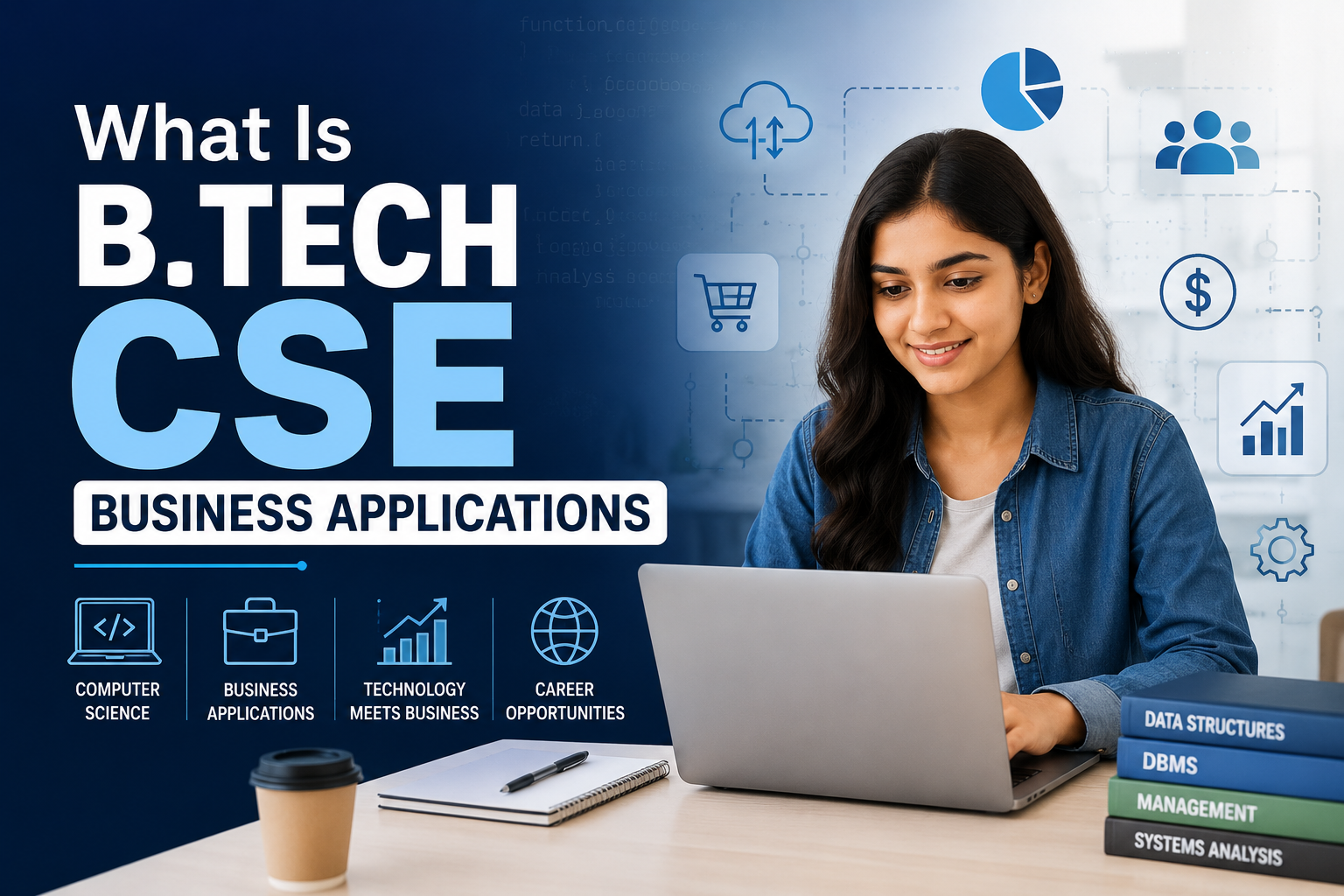
Most students who arrive at the engineering stream entrance carry a mental map of what B.Tech looks like: core computer science, lots of coding, a career in software development or IT. That map is not wrong; it describes the majority of engineering graduates. What it misses is a growing category of professionals the industry is actively trying to recruit but not finding in sufficient numbers: engineers who also understand business.
Every major technology company, consulting firm, and enterprise software vendor will say the same thing when asked what their hiring gap looks like: We can find engineers. We cannot find engineers who can sit in a room with a finance team, understand what the business actually needs, design a system that solves the right problem, and communicate the outcome to people who do not write code. That specific combination of technical competence plus business intelligence is the gap that this specialisation is built to close.
Understanding what B.Tech CSE business applications is not just a curriculum question. It is a question about what kind of professional you want to become and what kind of problems you want to spend your career solving. The students who choose this path are not choosing between engineering and business. They are choosing both and discovering that the combination opens doors that neither alone would.
Table of Contents
- 1. The Programme at a Glance: Everything You Need to Know
- 2. What This Degree Is Actually Doing Below the Curriculum
- 3. Who Is Actually Asking This Question and What They Are Really Trying to Decide
- 4. The Syllabus Year by Year, and What It Is Actually Building
- 5. How This Compares: Choosing the Right Specialisation
- 6. Where This Sits in the Emerging Technology Landscape
- 7. Career Scope Honest, Specific, and Grounded
- 8. 2026–2030: Where the Demand Is Going
- 9. What to Take Away From This
- 10. Where to Study These Two Starting Points
- 11. Frequently Asked Questions
The Programme at a Glance: Everything You Need to Know
Before the details, here is the full picture. This table covers the core programme facts that most students spend weeks searching for across multiple sources.
| Programme Detail | At a Glance |
|---|---|
| Programme Type | Undergraduate Engineering Degree (B.Tech) |
| Specialisation | Computer Science & Engineering Business Applications |
| Duration | 4 Years (8 Semesters) |
| Eligibility | 10+2 with Physics, Chemistry, Mathematics (PCM) from a recognised board |
| Core Subject Clusters | Programming & Software Engineering · Business Management & Strategy · Data Analytics & AI Tools · ERP & Enterprise Systems · Digital Marketing & E-Commerce · Project Management |
| Syllabus Focus | Technical computing skills integrated with real-world business application, every module tied to an industry outcome |
| Top Career Roles | Business Systems Analyst · AI-Augmented Product Manager · ERP Consultant · Digital Transformation Specialist · Business Intelligence Developer · Tech Entrepreneur |
| Starting Salary Range | ₹4–8 LPA (entry-level); ₹10–18 LPA (with 3–5 years + specialisation) |
| Recruiting Sectors | IT & Consulting · BFSI & Fintech · E-Commerce & Retail · Healthtech · EdTech · Manufacturing (Industry 4.0) |
| Programme Differentiator | Graduates can lead technology projects and understand business impact simultaneously, a profile that most engineering graduates lack |
(source: PayScale)
What this table makes visible is the integration principle at the heart of the programme: every technical module is taught in a business context, and every business module is taught with a systems lens. Students do not study engineering and then study business. They study engineering through business problems, which is how the industry actually uses both.
What This Degree Is Actually Doing Below the Curriculum
In most organisations, there is a persistent and expensive gap between the people who build technology and the people who use it to make business decisions. Engineering teams build technically excellent solutions that miss the actual business requirement. Business teams make decisions without understanding the technical constraints that affect them. The cost of this translation failure in wasted development cycles, misaligned products, and poor technology ROI runs into billions annually across Indian and global organisations. This degree is, at its core, a training programme for the professional who can stand in that gap and make it smaller.
Consequence: The Hybrid Engineer Commands a Different Trajectory
The career trajectory for a hybrid business-technology professional diverges from a pure engineering path in a specific way: they move into roles of broader responsibility faster. A software engineer who also understands financial systems becomes an invaluable asset in fintech. A developer who understands supply chain operations becomes the person leading digital transformation in manufacturing. The technical foundation provides the credibility; the business layer provides the leverage.
Who Is Actually Asking This Question and What They Are Really Trying to Decide
A student asking about this programme is usually navigating one of three specific dilemmas. The first: they are interested in technology but not in the idea of spending their career writing code. They want to build things that matter to businesses, which is different from building software for its own sake. The second: they are strong in both quantitative and communication skills and are looking for a path that uses both, rather than one that makes the other feel wasted. The third: they have heard that pure B.Tech paths can feel narrow, and they are looking for an engineering degree that builds toward management, consulting, or entrepreneurship without requiring a separate MBA to get there.
All three dilemmas point toward the same answer. But the decision of whether I should choose CSE business applications is not just about the programme; it is about self-knowledge. The students who thrive in this specialisation are those who are genuinely interested in how organisations work: why businesses make the decisions they do, how technology changes what is possible, and what it takes to lead a team through a system change. If that description resonates, the programme fits. If the deeper interest is in the technical challenge of building complex systems for their own sake, core CSE is the better match.
The Syllabus Year by Year, and What It Is Actually Building
A detailed look at B.Tech CSE business applications subjects reveals the integration logic more clearly than any programme description. Here is how the four years build on each other:
| Year | Technical Subjects | Business Subjects | Applied & Tools | Graduate Outcome |
|---|---|---|---|---|
| Year 1 | Programming fundamentals, Mathematics, Physics, Digital logic | Principles of Management, Business Communication | Problem Solving, Computational Thinking | Foundation in both engineering and business thinking |
| Year 2 | Data Structures, DBMS, Operating Systems, Networking basics | Financial Accounting, Economics, Organisational Behaviour | Excel & BI tools, Web fundamentals | Ability to design systems that serve business functions |
| Year 3 | Software Engineering, Cloud Computing, Cybersecurity basics | Marketing Management, Operations, Business Analytics | ERP systems, AI tools, Agile methodologies | Applied project work bridging tech and business domains |
| Year 4 | Advanced electives, Machine Learning introduction, API systems | Strategy, Entrepreneurship, Digital Transformation | Capstone industry project, Internship integration | Industry-ready profile with demonstrable applied portfolio |
What the year-by-year B.Tech CSE business applications syllabus makes clear is the sequencing logic: the first two years build the technical and business foundations in parallel; the third year integrates them through applied tools and real systems; the fourth year synthesises everything into industry-facing project work. Students do not spend four years learning theory and then apply it; they apply it from Year 2 onward.
How This Compares: Choosing the Right Specialisation
The comparison between B.Tech CSE business applications vs CSE is the most common decision a student in this space makes. It is also frequently framed incorrectly as a question of which is better, rather than which is right for a specific student with a specific career intent.
The three-way comparison that also frequently comes up is CSE business applications vs AI and data science, another decision that is best made by career intent rather than by perceived prestige or trending status. The table below maps all three specialisations across the dimensions that actually matter for a career decision:
| Comparison Factor | CSE Business Apps | CSE (Core) | CSE AI & Data Sci |
|---|---|---|---|
| Ideal For | Engineers who want to build and lead business systems | Engineers who want to code deeply and solve CS problems | Engineers who want to specialise in AI models and data science |
| Core Strength | Business + tech integration | Computer science fundamentals | AI algorithms + data pipelines |
| Technical Depth | Moderate applied and systems-level | High theoretical and applied | Very high maths, ML, and statistics |
| Business Depth | High integrated throughout | Low minimal business content | Low–Moderate data context only |
| Career Entry | Business Analyst, ERP Consultant, Product Manager | Software Developer, Systems Engineer, R&D roles | Data Scientist, ML Engineer, AI Researcher |
| Best Fit Student | Wants to work where technology serves business outcomes | Wants to build technology itself | Wants to research and build AI systems |
| Recruitment Scope | IT, consulting, BFSI, e-commerce, retail | IT product companies, core tech roles | Tech, research, fintech, healthtech |
Where This Sits in the Emerging Technology Landscape
AI and business applications closer than they appear
The relationship between AI and business applications engineering is not a future projection — it is the current reality of enterprise technology. Every major business system — ERP, CRM, supply chain management, and financial reporting — is now being augmented by AI layers that require professionals who understand both the underlying system and the AI enhancement. The business applications engineer who understands how AI integrates into these systems is the most immediately valuable profile in enterprise technology.
Where engineering specialisation is heading
The broader shift in future engineering specialisations is away from the general-purpose engineer and toward the domain-expert engineer. The market for someone who can code competently but has no industry domain knowledge is narrowing. The market for someone who combines strong technical fundamentals with deep expertise in a specific domain, such as finance, healthcare, logistics, or retail, is expanding. Business Applications is one of the clearest expressions of this direction.
What the job market is actually creating
The category of emerging tech and business jobs is growing faster than the pure technology job market. Digital transformation roles, AI integration roles, technology strategy roles, and business systems architecture roles are all expanding, and all require the combination of technical credibility and business fluency that this degree is designed to produce. These are not niche roles in large companies. They are mainstream requirements in mid-sized and large organisations across every sector.
Careers that sit at this intersection
The full landscape of business technology careers includes roles that did not exist a decade ago and will be among the most recruited in the next decade: Digital Transformation Lead, AI Integration Specialist, Business Systems Architect, Technology Strategy Consultant, and Product Manager for enterprise software. Each of these roles requires both a technical foundation that earns credibility with engineers and a business understanding that earns credibility with leadership. That combination is precisely what four years of integrated business applications engineering builds.
Career Scope Honest, Specific, and Grounded
What the first five years look like
The career scope of B.Tech CSE business applications opens in three directions simultaneously: consulting and advisory (where the business intelligence is the primary value), product and technology management (where the technical foundation earns the seat at the table), and enterprise systems (where both are required from day one). Entry-level graduates typically find roles as business analysts, junior product managers, ERP implementation associates, and digital operations coordinators.
Specific roles recruiting right now
The concrete picture of jobs after B.Tech CSE business applications includes: Business Systems Analyst (IT and consulting firms); ERP Functional Consultant (SAP, Oracle, Microsoft Dynamics implementations); Digital Transformation Associate (large enterprises undergoing technology change); Product Manager Enterprise Software; Business Intelligence Developer; and Technology Strategy Associate at consulting firms. All of these roles explicitly require the combination of technical and business competence and explicitly underrepresent candidates in their applicant pools.
What the numbers look like
The realistic picture of salary after B.Tech CSE business applications at the entry level ranges from ₹4 to ₹8 LPA, depending on the employer sector, city, and individual performance. With three to five years of experience and specialisation in a high-demand area — SAP consulting, AI-augmented analytics, and enterprise product management — the range moves to ₹12–20 LPA. The ceiling for hybrid business-technology professionals who move into leadership or consulting is significantly higher than the average engineering graduate trajectory.
The long view
The future scope of CSE business applications is strongest among engineering specialisations precisely because the trend it is built on — organisations needing professionals who understand both technology and business — is not a cycle. It is a structural shift driven by digital transformation, AI integration, and the increasing complexity of enterprise systems. The demand for this profile will not diminish as technology advances. It will grow, because advanced technology in business contexts requires more sophisticated integration thinking, not less.
2026–2030: Where the Demand Is Going
- Enterprise AI integration will be the defining technology challenge of the next five years. Every major organisation will be implementing AI into operational and financial systems. The professionals who can lead that implementation technically and organisationally will be among the most sought-after in the market.
- The product manager role is expanding and bifurcating. Technical product management, requiring engineering knowledge and business product management, requiring commercial and strategic knowledge, are increasingly distinct tracks. Business Applications graduates are positioned for both, which is a genuine structural advantage.
- Consulting demand for hybrid profiles will remain strong. The major IT and management consulting firms are among the most active recruiters of business-technology hybrid graduates. As digital transformation projects become longer, more complex, and more consequential, the value of professionals who can manage both the technical and human sides of those projects increases.
- ERP and enterprise systems are being rebuilt around AI. SAP, Oracle, and Microsoft are all embedding AI into their enterprise platforms. Professionals who understand the underlying business system and the AI layer being added to it are in a position that pure AI specialists and pure business graduates cannot easily replicate.
- Entrepreneurship in the B2B technology space is expanding. The combination of technical capability and business understanding is the foundation of most successful B2B technology startups. Graduates of business applications programmes who choose the entrepreneurship path are better prepared than most.
What to Take Away From This
The ones who emerge as leaders will not be those who coded the best, but those who understood what the code was for. This specialisation is a direct investment in that trajectory.
- This is not a compromise between engineering and business. It is a deliberate integration of both, and the market is actively paying a premium for that combination.
- The syllabus is built in sequence: technical and business foundations together in Years 1–2, integration in Year 3, synthesis in Year 4. Do not try to shortcut this sequence.
- Choose based on career intent, not trending status. Business Applications is the right choice for students who want to lead technology projects toward business outcomes. Core CSE is the right choice for those who want to build technology itself.
- Entry-level roles are accessible and clearly defined. The trajectory into consulting, product management, and digital transformation leadership is well-mapped and actively recruited.
- The future demand signal is structural, not cyclical. The need for hybrid business-technology professionals will strengthen as enterprise AI integration deepens, not weaken.
Where to Study These Two Starting Points
The programme described in this guide is available through a structured, credentialled pathway. Here are the two reference points worth exploring:
Frequently Asked Questions
Rather than five job titles, five role types are structurally resistant to automation. Roles requiring complex situational judgment strategy, governance, and risk management. Roles requiring trust-based human relationships negotiation, advisory, and client management. Roles that oversee and evaluate AI systems. Roles demanding original synthesis across disciplines. And roles involving accountability for outcomes. CSE Business Applications graduates are positioned for the first, third, and fourth of these, which is why the programme's hybrid profile is particularly well-suited to the AI-era economy.
Yes, particularly in AI-adjacent business roles: business analyst, AI product coordinator, operations manager in an AI-integrated workflow, and AI ethics reviewer. The caveat is that a commerce background without AI fluency limits the scope. A structured degree that integrates AI into a management or commerce curriculum produces a profile with significantly broader access to these roles than a standalone commerce degree.
The clearest path is a degree programme that builds both domain knowledge and applied AI competence simultaneously. For science stream students, B.Tech CSE with a business applications specialisation is a direct route. For commerce stream students, a BBA or B.Com programme with integrated AI learning is the equivalent entry point. In both cases, the degree provides the credibility and the structured learning environment; consistent applied practice during the degree provides the actual competence.
A degree programme with integrated AI learning is more effective than a standalone AI course at this stage, because it builds the domain foundation that makes AI skills applicable and meaningful. For students looking to enter the business-technology intersection, programmes that combine management or commerce with AI and analytics at UGC-recognised institutions provide the most complete preparation.
Business analyst, AI-augmented financial analyst, marketing technology specialist, AI operations coordinator, prompt engineer, AI content strategist, and data storyteller. All of these roles sit at the commerce-AI intersection and are accessible to graduates who combine domain expertise with AI tool fluency. The key is building applied AI competence alongside the commerce foundation, not treating them as separate tracks.
It is the most strategically sound direction available to a commerce student right now not because AI is fashionable, but because every sector that absorbs commerce graduates is being restructured by AI. The students who enter higher education with the explicit intention of building both commerce domain knowledge and AI fluency will graduate into a market that is actively seeking exactly their profile. The risk is in choosing a traditional path without AI integration and graduating into a market that has already moved.