
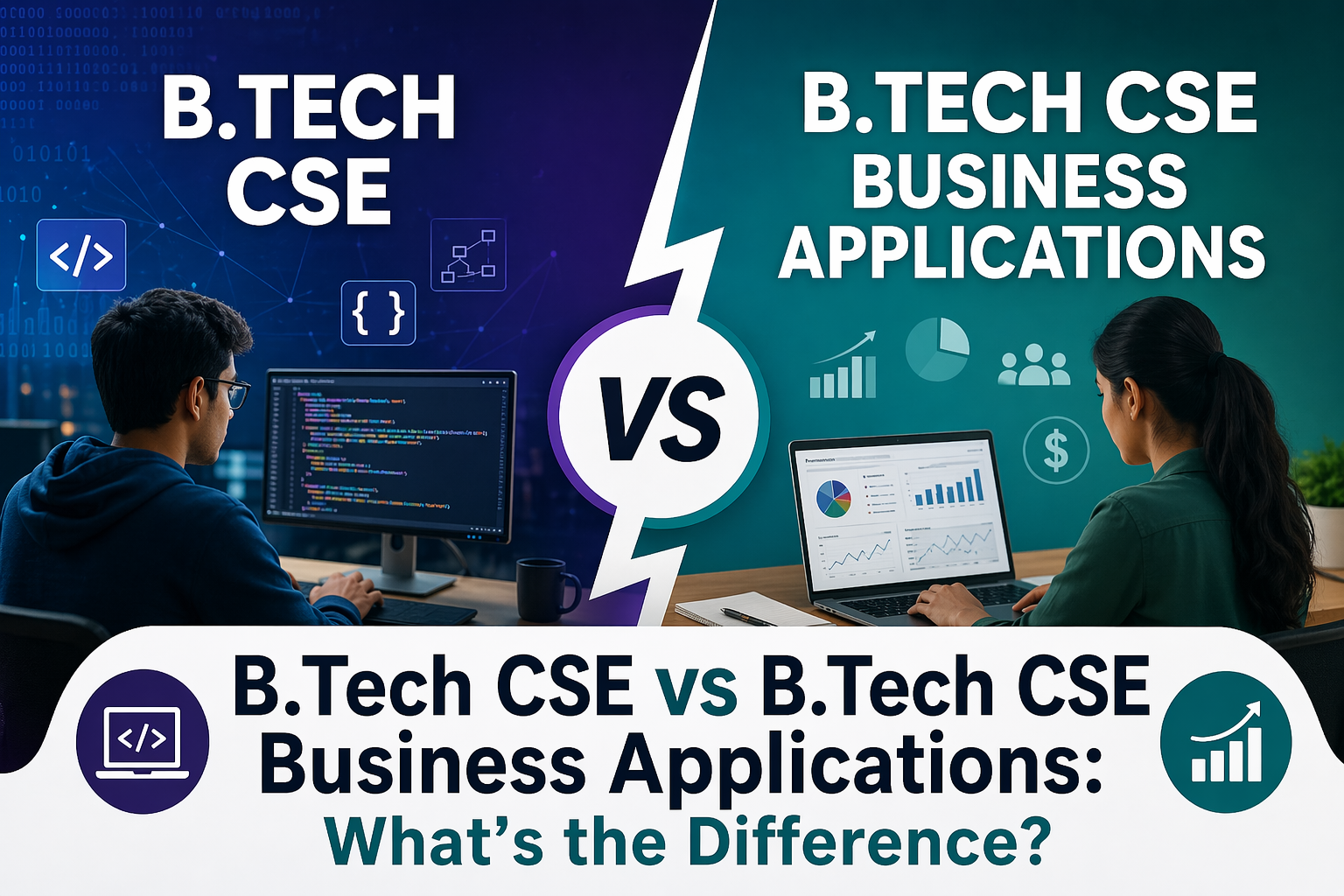
Walk into any engineering admissions counselling session and ask what the difference between B.Tech CSE and B.Tech CSE Business Applications is, and you will most likely get one of two answers. The first: “one is general, the other is specialised.” The second: “Both are the same, just with different electives.” Neither answer is complete. And the incompleteness of those answers is costing students a decision they could have made with more clarity.
The difference between CSE and CSE Business Applications is not just about subject choice. It is about the professional identity the degree is designed to build and the industry it is designed to place you in. A student who chooses between the two without understanding that distinction is making a four-year commitment on insufficient information.
This blog makes the distinction clear. Not to recommend one over the other universally, but to give you the framework to know which one is right for where you want to go.
What the Specialisation Actually Changes
Understanding what is the difference between B.Tech CSE and CSE Business Applications requires looking at three levels simultaneously: what is taught, how it is applied, and what kind of professional it produces.
A general B.Tech CSE is built around the core science of computing: algorithms, data structures, operating systems, computer architecture, networks, and software engineering. It is designed to produce a graduate who understands how computer systems work, who can write clean code, design efficient systems, and contribute to any software team. The career it aims for is broad: software developer, systems engineer, backend developer, DevOps, and the full spectrum of conventional software roles.
A B.Tech CSE with Business Applications specialisation retains all of that CS foundation; the core modules do not disappear, but add a second layer: the logic of how technology serves business. This means enterprise systems, business process automation, ERP platforms, product engineering for commercial contexts, cloud infrastructure for organisations, and data analytics tied to business decision-making. The graduate it produces understands not just how to build a system, but what business problem the system is solving and how its performance maps to commercial outcomes.
The hidden implication: the Business Applications specialisation is not a compromise on engineering rigour. It is an addition of a second dimension. A student who studies CSE Business Applications exits with the same core CS capability as a general CSE graduate, plus the ability to work at the boundary between technology and business, which is where most of the high-growth, high-compensation roles in the Indian economy currently sit.
What CSE with Business Applications Actually Is
It is an engineering specialisation that treats business organisations as the primary context for technology deployment. Where general CSE asks ‘how do we build this system?’, Business Applications asks ‘what does this organisation need, and how do we build a system that delivers it?’
In practice, this means the curriculum extends core CS into domains like enterprise resource planning, customer relationship management systems, e-commerce infrastructure, business intelligence, and the automation of workflows that organisations run on. It also means the programme develops the ability to communicate with non-technical stakeholders to translate between what a business needs and what a technology team can build. This translation capability is one of the most consistently cited gaps in engineering hiring, and it is one that the specialisation is specifically designed to address.
The profile it produces is increasingly in demand: an engineer who can walk into a business environment, understand what the organisation is trying to achieve, identify where technology can create leverage, and then build or implement the solution. This is the profile of a business analyst, a product engineer, a technology consultant, or an enterprise systems lead roles that sit at the most commercially valuable layer of technology deployment.
Who Should Choose Which and What the Decision Really Hinges On
Choose B.Tech CSE (General) if:
- You want to work in core software development, systems programming, or engineering roles where technical depth is the primary requirement and business context is secondary
- You are drawn to computer science as a discipline, algorithms, theoretical foundations, systems design and want the broadest possible foundation before specialising post-graduation
- You are targeting roles at large technology companies, product engineering firms, or research-oriented organisations where general CS fundamentals are the hiring filter
- You plan to pursue a postgraduate degree in CS, AI, or systems engineering, where the general foundation gives you the most flexible entry point
Choose B.Tech CSE Business Applications if:
- You want to work in business-facing technology roles, such as product management, IT consulting, enterprise systems, business analytics, or technology for e-commerce, BFSI, or manufacturing
- You are interested in how organisations use technology to operate more effectively, not just in how technology systems work in isolation
- You want a degree that builds both engineering credibility and business context simultaneously, so you are competitive for both technical and business-adjacent roles at graduation
- You are considering a career that may evolve toward product leadership, technology consulting, or enterprise architecture directions, where business application knowledge compounds significantly over time
What happens if the choice is made without this clarity?
A common pattern: students who choose general CSE while genuinely wanting business-facing roles spend their first two post-graduation years building domain context independently through courses, side projects, and on-the-job learning that the specialisation would have structured for them. Conversely, students who choose the Business Applications track without a genuine interest in organisational systems and business logic disengage from the domain modules and graduate without the differentiating capability the specialisation was designed to build. Fit is the variable that determines the outcome.
Course Architecture: What You Actually Study
The B.Tech CSE Business Applications course details reveal a curriculum designed in two integrated layers: a CS foundation that is common with general CSE, and a business applications layer that extends into enterprise and commercial technology contexts.
| Year | Core CS Modules | Business Applications Modules |
|---|---|---|
| Year 1 | Programming fundamentals (Python/Java), Mathematics for CS, Digital logic, Computer organisation | Introduction to business systems, Foundations of management, Business communication for engineers |
| Year 2 | Data structures and algorithms, Object-oriented programming, Operating systems, Database management systems | Enterprise systems and ERP fundamentals, Business analytics basics, E-commerce systems architecture, Cloud computing for business |
| Year 3 | Software engineering, Computer networks, Web development, Compiler design | Business intelligence and data visualisation, CRM systems and implementation, Business process automation, Product engineering for commercial contexts |
| Year 4 | Electives (AI, ML, cybersecurity, cloud), Major project | Industry-integrated capstone project, Internship assessment, Advanced business systems elective, Technology consulting case work |
The architecture makes clear that the specialisation does not replace the CS core; it extends it. A Year 3 student in Business Applications has covered the same algorithms, operating systems, and networks as a general CSE student, while also understanding how enterprise systems are built and how data drives business decisions.
What You Learn: The Skill Architecture in Detail
The programme builds five capabilities in parallel that general CSE does not develop at the same depth.
| Capability | What It Involves | Why It Matters for Career |
|---|---|---|
| Enterprise systems literacy | Understanding how ERP platforms (SAP, Oracle), CRM systems, and supply chain tools are architected, configured, and integrated | Most large organisations run on these systems. Engineers who understand them are immediately useful in IT consulting, enterprise software, and operations technology roles |
| Business analytics and BI | SQL at depth, data visualisation (Tableau, Power BI), business intelligence architecture, and translating data into decisions | Every organisation that runs on data needs people who can build the reporting and analytics layer that makes data useful to decision-makers |
| Product and systems thinking | Understanding requirements from business stakeholders, translating them into technical specifications, and evaluating trade-offs | The skill that separates a developer from a product engineer and product engineers command significantly higher compensation |
| Cloud and infrastructure for business | AWS / GCP / Azure fundamentals, deployment pipelines, SaaS architecture, and cost-efficient infrastructure design for commercial contexts | Cloud is now the default infrastructure layer for every significant business. Engineers who understand the business cost and performance implications are more valuable than those who understand only the technical layer |
| Communication and stakeholder management | Technical writing for non-technical audiences, presentation of system designs, and requirements elicitation from business teams | The single most underdeveloped skill in general engineering programmes, and the most commonly cited gap by employers hiring junior engineers into business-facing roles |
How the Specialisation Translates Into Business Career Advantage
The question of how CSE Business Applications help in business careers is best answered through the hiring logic of the companies that recruit this profile most actively.
In IT consulting firms Accenture, Infosys Consulting, Wipro, and Deloitte, the early-career roles that command the highest starting salaries are not pure development roles. They are technology analyst and business analyst roles that require the ability to understand a client's business problem, design a technology response, and communicate with both sides clearly. A general CSE graduate needs to learn the business side on the job. A CSE Business Applications graduate arrives with it already structured.
In product companies, both large and startup, the roles that offer the fastest progression are product engineering and product management roles, where engineering credibility and business judgment are both required. A B.Tech with a Business Applications specialisation is a natural fit for these roles in a way that a purely technical CS profile is not, and in a way that a purely business profile (BBA, MBA) cannot match for engineering credibility.
In e-commerce, fintech, and digital-first companies, the roles that matter most are those at the technology-business boundary: systems integration, platform analytics, technology operations, and business intelligence. These companies actively seek graduates who do not need to be taught either the technology or the business context, and the specialisation is specifically designed to produce that profile.
The Degree as a Career Investment: Evaluating the Profile It Builds
A B.Tech CSE Business Applications graduate entering the job market carries a profile that is genuinely distinct from the general CS graduate pool. The distinction is most visible in three specific situations: the interview, the first performance review, and the first promotion decision.
In the interview, the Business Applications graduate can answer the question that trips up most technical candidates: “Tell me about a project where you solved a business problem using technology.” This is a standard question in consulting, product, and enterprise technology roles, and it is a question the specialisation prepares students to answer authentically, because the programme is built around exactly this kind of applied problem-solving.
At the first performance review, the Business Applications graduate typically receives feedback that reflects faster-than-average contribution to business-facing deliverables because they arrived with the domain context to understand what those deliverables are trying to achieve. This translates into earlier trust from managers, earlier assignment to client-facing or cross-functional work, and a faster initial career trajectory.
Career Options After B.Tech CSE Business Applications
The range of roles available after completing this specialisation is wider than most students realise at the point of admission. The career landscape spans core technology roles, business-facing technology roles, and the growing category of hybrid profiles that sit between the two.
| Role | What You Do | Typical Employers | Starting Salary Range |
|---|---|---|---|
| Business Systems Analyst | Analyse organisational processes, identify technology solutions, and coordinate implementation between business and IT teams | IT consulting firms, large enterprises, and ERP vendors | Rs. 5–9 LPA |
| Product Engineer | Build features for commercial software products, work with product managers to translate business requirements into technical solutions | Product startups, SaaS companies, e-commerce platforms | Rs. 7–14 LPA |
| Technology Consultant (Junior) | Advise client organisations on technology strategy, systems selection, and digital transformation | Big 4 consulting, IT services, boutique digital firms | Rs. 6–12 LPA |
| Enterprise Application Developer | Build and customise ERP, CRM, and business intelligence systems for large organisations | SAP/Oracle partners, large IT services firms, and enterprises | Rs. 5–9 LPA |
| Data Analyst / BI Developer | Build dashboards, reporting pipelines, and analytics infrastructure that business stakeholders use to make decisions | All major sectors: BFSI, retail, healthcare, and FMCG | Rs. 5–9 LPA |
| E-Commerce Technology Lead | Manage the technology infrastructure of e-commerce platforms, integrate payment, logistics, and catalogue systems | E-commerce companies, D2C brands, retail-tech | Rs. 6–11 LPA |
| IT Project Manager (Junior) | Coordinate technology projects across business and technical teams, manage timelines, stakeholders, and deliverables | IT services, banking, and large enterprises | Rs. 5–8 LPA |
| Software Developer (Business Domain) | Write application code with a focus on business logic rather than infrastructure or systems programming | Any technology-using organisation | Rs. 5–10 LPA |
Where This Career Track Is Headed
More specifically, as AI tools become embedded in business operations, the most valuable engineers will be those who can identify which business processes benefit from AI, design the implementation, and communicate the change to non-technical stakeholders. This is precisely the skill set the Business Applications specialisation develops.
Side-by-Side: CSE vs CSE Business Applications
| Dimension | B.Tech CSE (General) | B.Tech CSE Business Applications |
|---|---|---|
| CS foundation | Full core CS curriculum | Same full core CS curriculum |
| Domain layer | No pure technical focus | Enterprise systems, business analytics, product engineering, cloud for business |
| Primary career track | Core software development, systems engineering, research | Business-facing technology: consulting, product, enterprise systems, BI |
| Industry range | Broadly, any technology-using sector | Broad but weighted toward IT consulting, e-commerce, BFSI, and manufacturing tech |
| Typical entry roles | Software Developer, Systems Engineer, DevOps, Backend Developer | Business Analyst, Product Engineer, Technology Consultant, BI Developer |
| Starting salary range | Rs. 4–12 LPA depending on company and role | Rs. 5–14 LPA premium for business-facing roles in consulting and product |
| Postgraduate fit | Strong for MS CS, MTech, and research programmes | Strong for MBA, MBA Tech, MS Business Analytics, MTech |
| Career ceiling | CTO, Principal Engineer, Head of Engineering | CTO, Head of Product, VP Technology, Chief Digital Officer |
| Best suited for | Student drawn to technical depth and core engineering | Student drawn to the technology-business intersection and organisational impact |
Key Takeaways
- B.Tech CSE and B.Tech CSE Business Applications share the same CS foundation. The difference is the second layer: Business Applications adds enterprise systems, business analytics, product engineering, and stakeholder communication.
- The specialisation does not limit career options; it directs them. The core CS modules keep general software engineering paths open, while the business layer adds accelerated access to consulting and product roles.
- The profile produces an engineer who can work at the technology-business boundary, a key hiring gap in IT consulting and digital-first businesses.
- Career progression is typically faster in business-facing roles because graduates arrive with domain context that general CS graduates build on the job.
- The right choice is a direction question, not a quality question. Both are rigorous engineering degrees.
FAQs
Both are four-year engineering degrees built on the same computer science foundation. The difference is in the specialisation layer: B.Tech CSE (General) focuses entirely on the technical science of computing algorithms, systems, and software engineering without a specific industry context. B.Tech CSE Business Applications adds a structured layer of enterprise and commercial technology knowledge alongside the CS core, including business systems, product engineering, business analytics, and the ability to work at the boundary between technical teams and business stakeholders. The result is a graduate who can contribute to both technical and business-facing roles, rather than only to one.
Yes, and the specialisation opens strong postgraduate pathways in both technical and business directions. For students who want to go deeper into technology, an MTech or MS in Computer Science, Data Science, or AI is a natural continuation of the CS foundation. For students who want to extend into business and management, an MBA, particularly with specialisations in technology management, analytics, or strategy, is an excellent fit. An MS in Business Analytics from a reputed institution is also a strong option.
Yes, for students entering roles at the technology-business boundary, it is one of the strongest engineering degrees available in 2026. The profile it produces is directly aligned with the fastest-growing hiring segments in the Indian economy: IT consulting, enterprise digital transformation, product engineering, business intelligence, and e-commerce technology. The demand for engineers who can operate at the intersection of technical systems and business outcomes is growing faster than the supply of graduates with that combination of capabilities.
The specialisation opens a broad range of roles. On the technical side: enterprise application developer, software developer with business domain focus, cloud solutions engineer, and database and BI developer. On the business-technology boundary: business systems analyst, product engineer, technology consultant, IT project coordinator, and e-commerce technology lead. As careers develop, these paths extend into product management, enterprise architecture, and eventually CDO or CTO roles.