
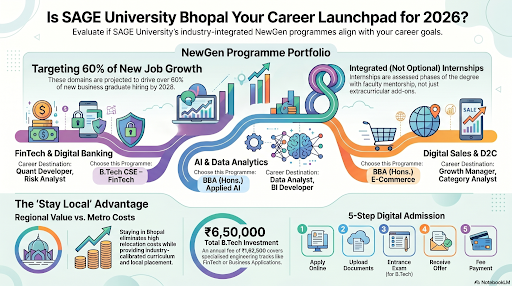
Students researching universities in central India are navigating a landscape where institutional reputation, programme design, fee structure, and career outcomes are rarely evaluated together. They compare names, look at rankings, and ask seniors, but the question most worth answering rarely gets asked directly: is this programme's architecture designed to produce graduates who can actually find the roles they are targeting?
The answer to that question looks different for every institution and every programme. For a university like SAGE University Bhopal, the answer requires looking past the headline and into the structure of what the programmes teach, how they connect academic learning to professional experience, and what the evidence of graduate outcomes actually shows.
That is what this blog does. It evaluates the university and its NewGen programmes through the lens of career outcomes, not as a promotional exercise, but as the kind of informed analysis a serious student should do before making a three-to-four-year commitment.
The Shift in What Career-Focused Education Actually Means
The term 'career-focused' has been adopted by almost every Indian university in its marketing. In most cases, it means very little: a placement cell, an internship requirement, and industry speakers at an annual event. What it rarely means is a fundamental redesign of how the degree is structured to ensure graduates exit with applied capability, professional experience, and demonstrable skills alongside their academic credentials.
Understanding how to choose a career-focused university in India requires distinguishing between universities that describe themselves as career-focused and those that have built their programmes around that outcome structurally. The markers of the latter are specific: internship integration assessed as part of the degree, curriculum calibrated to current industry requirements, digital learning that keeps content current, and placement infrastructure that is domain-specific rather than generic.
The NewGen model that underpins SAGE University's targeted programmes is a structural response to this gap, combining classroom learning with integrated internships and real industry exposure as core components of the degree, not electives or add-ons. Whether that structural intention translates into career outcomes is the question worth examining.
The SAGE University career focused courses B.Tech CSE (Business Applications), B.Tech CSE (FinTech), BBA (Hons.) in Applied AI and Business Analytics, and BBA (Hons.) in E-Commerce are each designed with a specific career destination in mind. This specificity is an advantage for students who are clear about their direction, and a risk for those who are not.
Is SAGE University Bhopal the Right Choice? An Honest Assessment
Who is well-suited for these programmes:
- Students in Bhopal and the broader Madhya Pradesh region who want access to industry-integrated education in digital, AI, and tech-enabled business domains without the cost and disruption of relocating
- Those who are clear about wanting careers in e-commerce, AI-enabled analytics, financial technology, or technology for business, and want their degree to reflect that specificity from Day 1
- Students who learn better through applied, project-based learning and are prepared to engage actively with internship and industry exposure components, not just classroom study
- Those who have done their due diligence on the specific programme placement record, faculty quality, internship infrastructure and have evidence-based confidence in the outcome
Who should think carefully before choosing:
- Students who are undecided about their career direction, the NewGen programmes are domain-specific, and choosing one without a genuine interest in the domain reduces the value of the entire curriculum
- Those targeting career paths in conventional engineering functions, core finance, or government service, for those directions, a different programme architecture may serve better
- Students who are choosing primarily on the basis of fees or proximity without evaluating programme quality and placement outcomes, cost efficiency is relevant, but not as the primary decision variable
What the NewGen Programmes at SAGE University Build
The question of what courses are offered at SAGE University Bhopal across the NewGen portfolio spans two engineering tracks and two business tracks, each designed with a different career destination but sharing the same structural model: academic rigour combined with integrated internship experience and real industry exposure.
| Programme | Core Learning Areas | Career Destinations | Industry Sectors |
|---|---|---|---|
| B.Tech CSE – Business Applications | Software engineering fundamentals, business process automation, ERP systems, product development, data structures, cloud computing, AI for business | Software Developer, Business Systems Analyst, Product Engineer, IT Consultant, Tech Lead | IT services, consulting, e-commerce, BFSI, manufacturing tech |
| B.Tech CSE – FinTech | Financial technology systems, algorithmic trading, blockchain, digital payments, credit risk modelling, AI in banking, regulatory tech | FinTech Developer, Risk Systems Engineer, Payments Analyst, Quant Developer, Digital Banking Analyst | Fintech startups, banks, NBFCs, investment platforms, insurance tech |
| BBA (Hons.) Applied AI & Business Analytics | Business analytics, machine learning applications, Python for business, data visualisation, statistical modelling, AI-enabled decision-making | Data Analyst, Business Analyst, BI Developer, AI Product Analyst, Growth Analyst | Technology, BFSI, retail analytics, healthcare, consulting |
| BBA (Hons.) E-Commerce | Digital marketing, e-commerce operations, platform analytics, D2C models, supply chain for digital commerce, and marketplace management | E-Commerce Executive, Digital Marketing Manager, Category Analyst, D2C Brand Manager, Growth Manager | E-commerce platforms, D2C brands, digital agencies, retail-tech |
The FinTech engineering track is the most specialised of the four. It narrows the career destination but narrows it toward a high-demand, high-compensation segment where the supply of qualified graduates consistently lags demand. Students who are genuinely drawn to the intersection of financial systems and technology should consider it seriously.
The Internship Component: What Integration Actually Looks Like
The question of whether SAGE University Bhopal with internship programmes is answered structurally by the NewGen model itself; internships are not optional, supplementary, or self-arranged extras. They are built into the programme timeline as assessed components, timed to coincide with academic preparation, so students enter the internship with the foundational knowledge to contribute meaningfully.
In practice, this means the internship is a phase of the degree, not a break from it. Faculty mentors remain engaged during the placement. Performance is reviewed and assessed. The work done during the internship feeds back into the academic record, which creates accountability on both sides: the institution is invested in the quality of the placement, and the student is assessed on more than just what they did in a classroom.
The students who extract the most from this model are those who treat the internship as the most important semester of their degree, not the easiest one. The organisations that take interns under a structured programme watch for initiative, professional communication, and the ability to apply concepts independently, exactly the skills the classroom modules are designed to build.
How the Programme Model Supports Career Growth
The question of how SAGE University Bhopal helps in career growth is best answered through the career translation logic of the NewGen model rather than through placement statistics alone.
Career growth in digital and tech-enabled domains is driven by three things in the first five years: the quality of the first role (whether it is genuinely applied or just credential-filling), the pace of skill accumulation (whether the student is building on a strong foundation or starting from scratch), and professional network depth (whether the student has industry relationships from the degree years that continue to open doors). The NewGen model addresses all three through a domain-specific curriculum, assessed internship experience, and industry exposure that begins during the degree rather than after it.
The long-term career implication: graduates who enter their first role with applied experience, a portfolio of real work, and a clear professional identity in their domain move faster in the first three to five years than those who arrive with only academic preparation. The gap is most visible at the first performance review and the first promotion decision.
Is the University a Good Choice? An Evidence-Based View
The question of whether SAGE University Bhopal is good for students considering these programmes requires an honest answer across four dimensions: academic quality, infrastructure, industry connection, and career outcomes.
On academic quality: the NewGen programmes are designed with current industry requirements in mind, with a curriculum that reflects the tools and methods being used in actual roles today, not inherited from a decade-old syllabus. The faculty mix across technical and business modules determines how well this intention translates into the classroom, and prospective students should ask specifically about the practitioner-to-academic ratio in their target programme.
On infrastructure: SAGE University has invested in campus facilities, digital learning infrastructure, and laboratory environments that support the applied learning components of its engineering and analytics programmes. For programmes that require hands-on computing, data tools, and project work, this matters.
On industry connection: the placement cell's track record and employer network are the most direct measures of career outcome quality. Prospective students should ask for domain-specific placement data, not aggregate placement percentages, but the companies and roles specifically relevant to their target programme.
Understanding the Fee Structure: What to Know Before You Decide
For most students considering SAGE University, the SAGE University Bhopal fees structure is a significant part of the decision, and it deserves honest evaluation rather than either dismissal or overemphasis.
The relevant question when evaluating fees is not whether the programme is cheap, but whether the return on the investment is commensurate with the cost. A programme with moderate fees that produces strong career outcomes is a better financial decision than a cheaper programme that does not. The SAGE University Bhopal courses and fees should be evaluated against the specific career trajectory each programme enables, starting salary, growth rate, and the quality of the first role not against the headline cost alone.
For the B.Tech programmes, the SAGE University Bhopal B.Tech fees sit within the mid-range for private engineering universities in Madhya Pradesh. Specialised programmes such as B.Tech CSE (Business Applications) and B.Tech CSE (FinTech) are offered over a duration of four years, with an annual academic fee of ₹1,62,500 and a total programme cost of ₹6,50,000.
When evaluated in isolation, this may appear comparable to other private universities; however, a more accurate assessment considers the total cost of education. Expenses associated with relocating to metro cities, including accommodation, living costs, and travel, often offset or even exceed the perceived fee advantage of better-known institutions. The more relevant comparison, therefore, is not annual tuition alone, but the overall investment required to complete the degree.
Students are also advised to explore scholarship opportunities, merit-based fee reductions, and education loan options during the application process, all of which affect the net cost of the programme significantly.
The Admission Process: What to Expect and How to Prepare
The SAGE University Bhopal admission process follows a structured online pathway for both the BBA and B.Tech programmes. Understanding the steps before you begin reduces friction and helps you prepare the right documents in advance.
Admission Journey for BBA Programmes (Applied AI & Business Analytics / E-Commerce):
Log in to the application portal and complete your application form
Upload the required documents through the portal
Accept the offer and pay the admission fees to secure your seat
Eligibility is based on your Class 12 board exam results.
Admission Journey for B.Tech CSE Programmes (Business Applications / FinTech):
Log in to the application portal and begin your application form
Upload all required documents through the portal
Appear for the university entrance exam
Score a minimum of 40% marks to be eligible for admission
Accept the offer letter and pay the admission fees to confirm your seat
Eligibility is based on your Class 12 board exam results and your SAGE Entrance Exam score.
A few practical notes on the admission process: prepare your Class 12 marksheet, transfer certificate, and identity documents before starting the portal application. Uploading incomplete documents is the most common cause of avoidable delays. For the B.Tech entrance exam, the 40% minimum marks threshold is relatively accessible, but students who prepare for the exam rather than treating it as a formality tend to demonstrate the kind of academic readiness that benefits them through the programme.
Choosing Between the Four Programmes: A Decision Framework
| If you want to… | Best Programme | Why |
|---|---|---|
| Build software for business systems and digital products | B.Tech CSE – Business Applications | Combines engineering depth with business logic, strong for product and IT consulting roles |
| Work at the intersection of technology and financial services | B.Tech CSE – FinTech | The most specialised track has high demand, high compensation, but a narrower initial pathway |
| Use data and AI to drive business decisions across industries | BBA (Hons.) Applied AI & Business Analytics | A business degree with analytics depth is strong for analyst and data roles across all sectors |
| Build a career in e-commerce, digital marketing, or D2C brands | BBA (Hons.) E-Commerce | Purpose-built for the digital commerce hiring market, the fastest path to relevant roles |
| Keep career options open across tech and business (undecided) | B.Tech CSE – Business Applications or BBA Applied AI | Broader applicability, but revisit the decision once direction is clearer |
Where These Career Paths Are Headed
The specific demand signals worth noting: AI in business is moving from experimental to operational across Indian enterprises, creating sustained demand for graduates who understand both the technical and business dimensions. FinTech is entering a phase of regulatory maturation where compliance-aware technical talent is scarce and well-compensated. E-commerce continues to expand into Tier 2 and Tier 3 geographies, including Madhya Pradesh, creating local hiring demand that did not exist five years ago. The graduates entering these programmes now are entering ahead of, not behind, these curves.
Key Takeaways
- SAGE University's NewGen programmes are domain-specific and career-integrated. They are designed for students who are clear about their direction, not for those looking for a generic degree.
- The internship component's value is a function of how deeply it is integrated into the academic structure. The key questions to verify: is it assessed, institutionally supported, and timed to academic preparation?
- Fee evaluation should account for the total cost of the degree, including accommodation and living costs, for alternatives, not just annual tuition. On a total-cost basis, staying local often reverses the apparent advantage of metro institutions.
- The B.Tech CSE FinTech track is the most specialised of the four programmes and maps to one of the highest-demand, highest-compensation entry-level profiles in the Indian economy. It is best suited to students with a genuine interest in financial technology.
- The admission process is fully online and straightforward, but preparing documents before starting the portal application reduces friction significantly.
- The career domains these programmes target are growing faster than overall business graduate hiring. Students entering these fields from well-designed, applied programmes in 2026 are entering at a favourable point in the demand curve.
FAQs
SAGE University Bhopal is a private university established under the Madhya Pradesh Private University Act, recognised by the UGC. It holds NAAC accreditation, which is the primary national quality benchmark for Indian universities. For national rankings under frameworks like NIRF, specific ranking positions change annually, and prospective students should verify the most current data directly through the NIRF portal or the university's official communications. Rankings are one input into the evaluation; they are best used alongside programme-specific placement data, faculty quality, and infrastructure assessment, rather than as the sole decision criterion.
The university offers programmes across engineering, management, science, law, pharmacy, and agriculture. Within the NewGen portfolio specifically, the four career-integrated programmes are: B.Tech CSE – Business Applications, B.Tech CSE – FinTech, BBA (Hons.) in Applied AI and Business Analytics, and BBA (Hons.) in E-Commerce. These are designed around the NewGen model, combining structured classroom learning with integrated internships and real industry exposure. For the full range of programmes across all schools and departments, the university's official website provides the current course catalogue with eligibility, duration, and fee details.
For students entering the domains the NewGen programmes target business technology, financial technology, AI-enabled analytics, and digital commerce and who engage fully with the applied and internship components, yes. The programme architecture is designed to produce industry-ready graduates rather than conventionally-credentialled ones.
Yes, and more specifically, internships are integrated into the NewGen programme structure as assessed components, not optional add-ons. The university's placement infrastructure supports the facilitation of internship placements with corporate partners, and faculty mentors are engaged during the internship period.
Yes. SAGE University Bhopal is a UGC-recognised private university established under state legislation, and its degrees carry the same legal standing as those from other UGC-recognised institutions for private sector employment, government employment, and higher education admissions.