Increasingly, employers are concerned about the gap: graduates who understand theory well but have never actually applied it under real workplace conditions. At the same time, few students can justify giving up all flexibility for a fully rigid, campus-only routine.
A format built specifically to sit between these two extremes has been gaining ground quietly for several years, and it is worth understanding clearly rather than treating as just another marketing label.
Table of Contents
- 1. Why This Format Is Having a Moment
- 2. The Bigger Shift This Sits Inside
- 3. Breaking Down the Mechanics
- 4. Where This Shows Up at the Undergraduate Level
- 5. Where Higher Education Is Actually Heading
- 6. What Employers Are Actually Screening For
- 7. Working Well With Others, On Purpose
- 8. What to Verify Before Choosing This Path
- 9. A Way to See the Format Clearly: The Blended Learning Value Stack
- 10. Benefits Worth Recognising in This Format
- 11. Trends Reinforcing This Shift
- 12. Roles This Kind of Preparation Supports
- 13. Bringing the Format Together
- 14. Frequently Asked Questions
Why This Format Is Having a Moment
The push behind blended education in 2026 is straightforward: employers want graduates who can walk in with both academic depth and demonstrated applied experience, and a format that builds both into the degree itself. Rather than leaving practical exposure to chance, NewGen Degrees answers that demand directly.
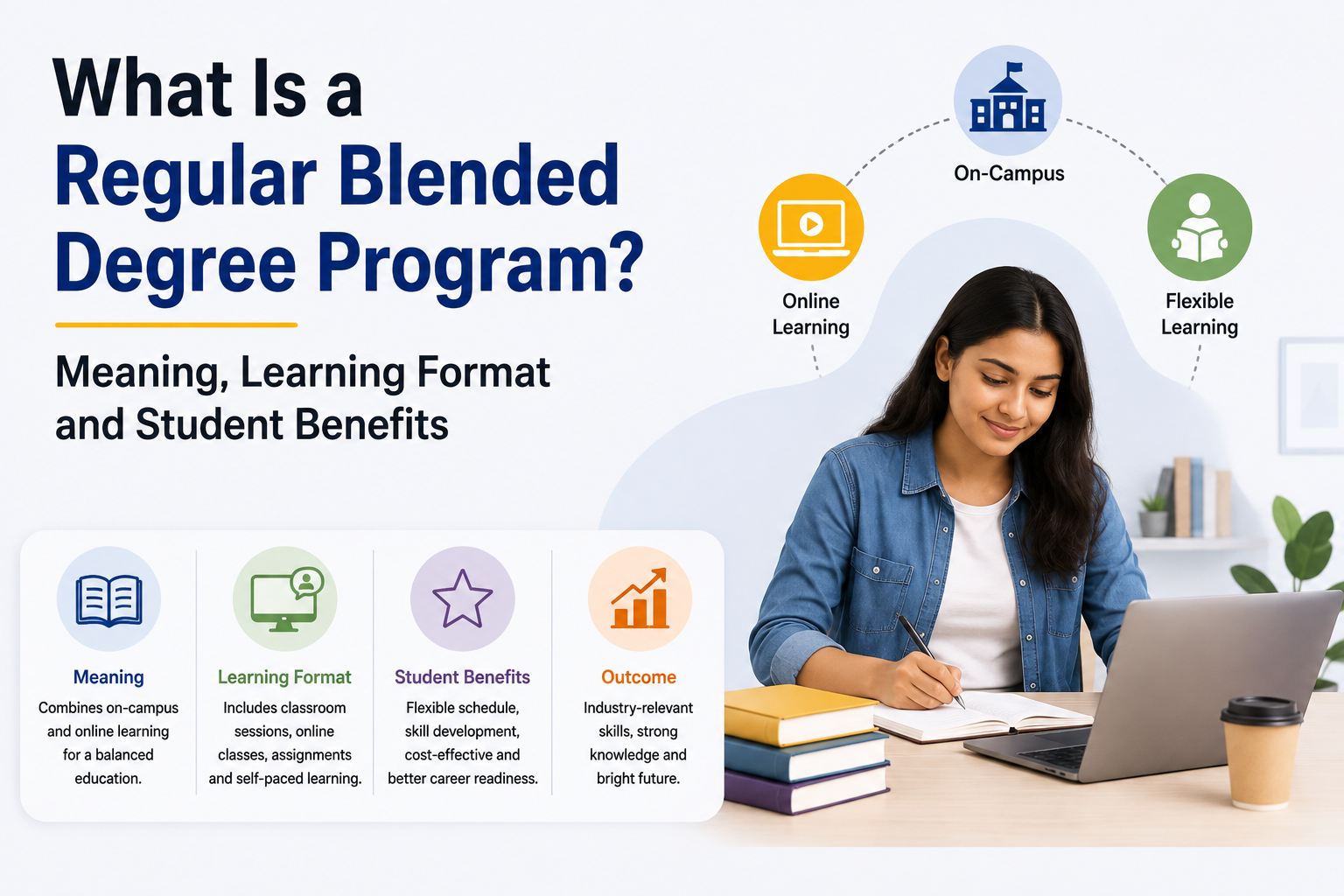
The term hybrid degree program is often used interchangeably with 'blended,' though in practice a hybrid programme tends to split time roughly evenly between online and campus learning. While a blended programme more deliberately integrates the two into a single, continuous learning experience rather than alternating between them.
The Bigger Shift This Sits Inside
Zooming out, blended education is part of a broader move across higher education toward formats that treat flexibility and structure as complementary rather than opposing goals.
For a student juggling coursework alongside internships, part-time work, or family responsibilities, flexible learning built into the weekly structure rather than bolted on as an afterthought is often the single biggest practical draw of this format.
None of this works without solid infrastructure. Technology-enabled learning management systems, recorded lecture access, and digital assessment tools are what actually make it possible to blend in-person and remote learning without losing consistency or academic rigour.
Breaking Down the Mechanics
Understanding what actually happens week to week makes the format far less abstract.
A closer look at how blended degree programs work typically reveals a structure where core theory is delivered through a mix of scheduled campus sessions and recorded or live digital classes, while structured internships and real industry exposure are integrated directly into the curriculum itself, rather than left as an optional add-on a student has to arrange independently.
For most institutions offering this format, regular blended degree admission follows a familiar undergraduate process: application, eligibility verification, and in some cases a short aptitude or counselling round without the additional entrance-exam hurdles that some fully residential programmes require.
Where This Shows Up at the Undergraduate Level
This model has become especially common among undergraduate blended courses in business, computer applications, and design fields, where practical, project-based exposure meaningfully changes how job-ready a graduate feels on day one.
Curious what this actually looks like once classes begin? A closer look at the Regular Blended Degree Programs Bhopal
Part of the appeal here is forward-looking. Future ready education is less about predicting exactly which skills will matter in a decade and more about building the habit of continuous, applied learning that adapts as the job market itself changes.
Where Higher Education Is Actually Heading
Broader higher education trends point consistently in this direction toward formats that blend structure with flexibility, and toward curricula that treat applied skill-building as core rather than supplementary.
Structurally, this format is built on skill-based learning principles, weighting practical, project-driven coursework as heavily as traditional theoretical instruction, rather than treating hands-on skill-building as something to be picked up informally after graduation.
This is what separates genuinely career-oriented degree programs from ones that simply add a token internship at the end; the difference lies in whether real industry exposure is woven through the curriculum from the start, or left as a single, disconnected requirement before graduation.
What Employers Are Actually Screening For
Recruiters increasingly describe the employability skills they look for in fairly consistent terms: demonstrated project work, comfort with common workplace tools, and evidence that a candidate can apply classroom knowledge to a real, messy business problem.
This is why practical learning components internships, live projects, and applied assignments sit at the centre of a blended format rather than functioning as an occasional supplement to lecture-based coursework.
Alongside subject knowledge, strong digital skills for students comfort with collaborative software, data tools, and common workplace platforms are built in naturally, simply because the learning format itself requires regular use of these tools.
Working Well With Others, On Purpose
Group projects and live campus sessions also give this format a natural advantage in building collaboration skills, since students regularly work across both in-person and digital settings, mirroring how most modern workplaces actually operate.
Applied projects, by design, rarely have a single textbook answer, which is exactly why this format tends to build stronger problem solving skills than a purely lecture-and-exam structure, where correct answers are usually predetermined.
Taken together, these habits build toward genuine future workplace skills: adaptability, applied problem-solving, and comfort with digital tools that remain valuable even as specific job responsibilities shift over a career.
What to Verify Before Choosing This Path
None of these benefits matters if the underlying degree itself is properly recognised, which makes institutional accreditation the one detail worth checking directly rather than assuming.
Before enrolling anywhere, it is worth confirming the institution's standing directly through the official UGC Recognised University Bhopal
Comparing the Formats: Blended Versus Fully Online
A common point of confusion is exactly how a regular blended degree vs online degree actually differs in practice, since both involve digital coursework. The clearest distinction is the presence of structured, in-person campus interaction and direct access to hands-on facilities in a blended format, which a fully online degree generally cannot replicate.
| Factor | Regular Blended Degree | Fully Online Degree |
|---|---|---|
| In-person interaction | Scheduled campus sessions combined with digital learning | Minimal to none; almost entirely screen-based |
| Practical and lab exposure | Direct, on-campus access for hands-on components | Simulated or virtual, with variable depth |
| Internship and industry integration | Often built directly into the curriculum structure | Usually left to the student to arrange independently |
| Peer network | Mixed in-person and digital cohort | Almost entirely digital |
| Best suited for | Students who want structure with flexibility | Students needing maximum location independence |
Comparing the Formats: Blended Versus Fully Traditional
The other common comparison, a regular blended degree vs traditional degree, comes down to flexibility and built-in digital and applied skill-building. A traditional, fully on-campus degree offers a familiar, fixed structure, while a blended degree keeps that campus foundation while deliberately weaving in flexibility and technology-driven skill development.
| Factor | Regular Blended Degree | Fully Traditional, On-Campus Degree |
|---|---|---|
| Weekly structure | Mix of in-person classes and self-paced digital modules | Fixed, entirely in-person timetable |
| Use of digital tools | Built into the core learning experience | Often limited to supplementary resources |
| Pace and flexibility | Some self-paced elements alongside scheduled sessions | Little flexibility; pace set entirely by the institution |
| Skill-building focus | Explicit emphasis on digital and applied skills alongside theory | Primarily theory-led, with practical exposure added separately |
| Best suited for | Students who want campus experience without a rigid, fully fixed schedule | Students who prefer a fully structured, conventional routine |
Put together, the practical career benefits of a regular blended degree tend to show up earliest in the hiring process itself: stronger interview performance, a portfolio of real project work, and noticeably less of an adjustment period once a graduate actually starts a job.
A Way to See the Format Clearly: The Blended Learning Value Stack
Rather than describing this format as one single thing, it helps to see it as four layers stacked on top of each other, each depending on the one below it.
Benefits Worth Recognising in This Format
- Structured flexibility, rather than an all-or-nothing choice between rigid and unstructured formats
- Practical, resume-ready project work built into the curriculum itself
- A campus community and peer network, without a fully fixed daily schedule
- Natural, ongoing exposure to digital tools used in most modern workplaces
- Stronger interview readiness through demonstrated, applied project experience
- Smoother transition into a first job, with less on-the-job catch-up required
- A more balanced daily routine for students managing other commitments
- Continuous skill-building that keeps pace with a changing job market
Trends Reinforcing This Shift
- Growing employer preference for demonstrated applied experience over theory alone
- Wider institutional adoption of technology-enabled, flexible learning formats
- Increasing integration of structured internships directly into degree curricula
- Rising student demand for formats that balance flexibility with genuine structure
- The gap between academic knowledge and workplace readiness has widened in many fields
- Employers increasingly screen for applied skills before formal interviews even begin
- Fully rigid and fully unstructured formats both leave real gaps; this model is built to close
- Early digital fluency compounds into a meaningful long-term career advantage
Roles This Kind of Preparation Supports
Graduates from career-oriented, blended degree formats commonly move into roles such as:
Bringing the Format Together
A regular blended degree is best understood not as a compromise between online and traditional learning, but as a deliberate combination of both, built specifically to close the gap between academic knowledge and workplace readiness. For a student weighing structure against flexibility, and theory against practical experience, this format is designed to avoid making that a trade-off in the first place.
Frequently Asked Questions
A blended degree keeps the campus foundation of a traditional degree while deliberately weaving in digital coursework, flexible scheduling, and structured practical exposure, rather than relying entirely on a fixed, in-person-only routine.
The clearest benefits are built-in practical experience through integrated internships, stronger digital and problem-solving skills developed naturally through the format, and a more manageable balance between structure and flexibility than either fully traditional or fully online alternatives typically offer.
It tends to suit students who want a genuine campus experience and peer network, but also need some flexibility to manage other commitments, and who value graduating with demonstrated practical experience rather than theory alone.
AI tools are increasingly used within this format for personalised learning support, faster feedback on assignments, and exposure to the same AI-assisted research and analysis tools students will likely use in their first job, adding a layer of practical, future-relevant skill-building on top of the core curriculum.