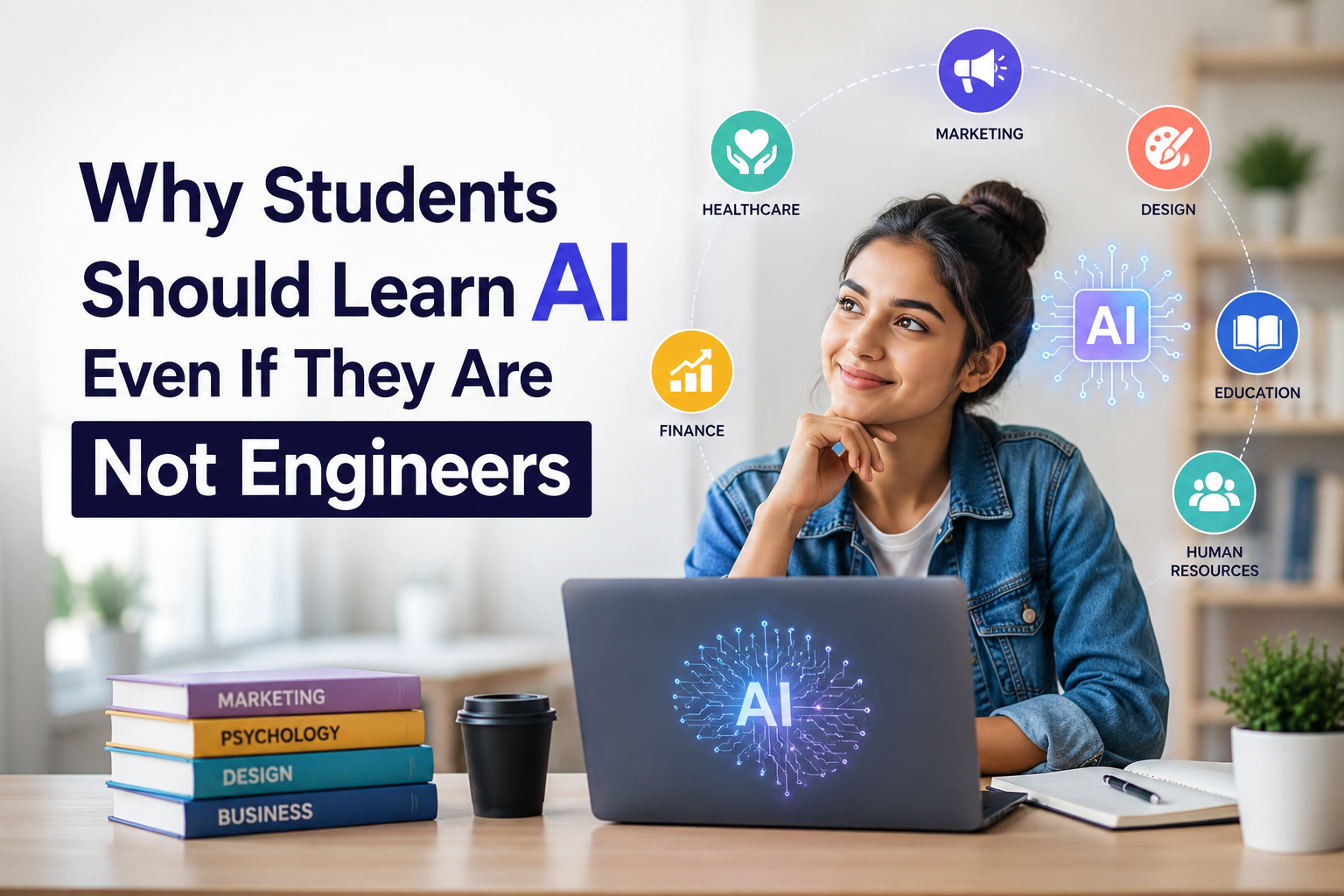
Most students arrive at the AI conversation through the Tools & Skills or Career & Jobs row. The ones who stay and compound their advantage are those who also engage with the Education & Learning and Future Readiness rows. Keep this map in mind as you read.
The Engineering Assumption and Why It Is Wrong
Somewhere along the way, a damaging idea took hold: that artificial intelligence is for engineers. If you are studying commerce, you do not need to understand it. If your background is media, management or humanities, AI is someone else's problem. This assumption is not just wrong; it is the single biggest barrier keeping capable students out of one of the most significant shifts in the modern economy.
Here is the reality. The engineers build the systems. Everyone else needs to learn to use them, evaluate them, govern them, and make decisions with them. A marketing manager who cannot interpret an AI-generated campaign report is at a disadvantage relative to one who can. A finance analyst who cannot distinguish between a reliable and an unreliable AI-produced projection is a liability. A business strategist who does not understand what AI can and cannot automate is planning in the dark. The professional case for AI for students across every discipline is not aspirational; it is already urgent.
The more uncomfortable truth is this: the students who are waiting for AI to become relevant to their field are the ones who will look up in two years and discover the field has reorganised around a skill set they chose not to build. That is not a prediction it is already the pattern in several sectors.
What Is Actually Happening Below the Surface
The conversation about AI and employment is almost always framed as replacement: which jobs will AI take? That framing misses a more important dynamic. Within every field, AI is reorganising the allocation of cognitive work. Tasks that were previously distributed across a team, such as data gathering, first-draft production, basic analysis, and routine reporting, are being consolidated into AI-assisted workflows. The humans in those workflows are not being removed; they are being repositioned. Their value now comes from what they bring to the output, not from producing the output itself. Understanding artificial intelligence skills is about understanding where your value gets repositioned and making sure you are ready for that position.
Consequence: The Literacy Gap Is Already Visible
In hiring conversations across India's major sectors in 2026, a consistent gap is emerging: candidates who understand their domain but have no engagement with AI tools, and candidates with surface-level AI familiarity but no domain depth. Neither is what employers are looking for. The AI education conversation is ultimately about closing this gap, building professionals who bring domain expertise and AI fluency together, rather than treating them as separate concerns.
What Students Are Actually Feeling Right Now
The most honest conversation about AI and students is not about skills lists or job projections. It is about the specific anxiety of watching a landscape shift while you are still in the middle of building your foundation. A student in their second year of a commerce degree did not sign up to also become an AI practitioner. And yet the world they are graduating into will expect a baseline of AI courses after 12th, awareness that most curricula have not yet integrated.
There is also a class of students who are quietly confident that AI does not apply to them. The humanities student who plans to work in communications. The commerce student who plans to join a family business. The management student who plans to work in HR. Each of these students has a version of "AI is for the tech people" that feels locally true and is globally false. AI is entering every one of these domains, and the question is not whether it will affect those students, but whether those students will be positioned to direct the change or absorb it.
Who Needs This and Who Is Kidding Themselves
Who should engage with AI learning right now?
Any student who plans to work in an organisation of more than five people within the next ten years. That is not an exaggeration; it is a description of where AI integration is heading. The ChatGPT for students conversation is an entry point, not the destination. Starting there, using a tool that is immediately accessible, immediately useful, and immediately educational about how AI systems behave is a legitimate first step for any student, regardless of background.
What happens to the student who waits?
In most cases, waiting does not result in catastrophe it results in compounding disadvantage. A student who graduates in 2027 without any AI fluency will find themselves in onboarding processes that assume it, in performance reviews that flag its absence, and in promotion pipelines that reward those who have it. The cost of waiting is rarely visible at the point of decision; it accumulates in the two years after graduation.
What about students who genuinely dislike technology?
This is worth addressing directly. The AI tools for education ecosystem in 2026 are substantially more accessible than it was even eighteen months ago. Tools designed for non-technical users, writers, analysts, communicators, and planners require no more technical aptitude than using a search engine did in 2005. The question is not whether a student likes technology. It is whether they are willing to engage with a new interface for a task they already do.
How AI Is Showing Up Across Industries Right Now
This is not a projection of what will happen. These are descriptions of what is already happening in four sectors where non-engineering graduates are the primary workforce:
| Sector | Keyword | How AI Is Being Applied |
|---|---|---|
| Business | AI in Business | Demand forecasting, process automation, customer analytics, and competitive intelligence |
| Marketing | AI in Marketing | Content personalisation, ad optimisation, consumer sentiment analysis, campaign reporting |
| Finance | AI in Finance | Fraud detection, credit risk modelling, algorithmic trading, automated financial reporting |
| Media | AI in Media | Automated journalism, content recommendation, audience analysis, and synthetic media production |
What this table makes visible is that generative AI skills are already embedded in the workflows of roles that have nothing to do with software development. A marketing coordinator who cannot navigate an AI-driven campaign optimisation platform is operating below the current baseline expectation in many agencies. A finance analyst who has not been asked to work with AI-generated projections yet will be within two years.
The Path That Requires No Engineering Background Whatsoever
Starting Without Code
The proliferation of no-code AI tools is arguably the most significant development in AI democratisation over the past two years. Tools that generate content, analyse data, build workflows, and produce structured outputs all through natural language interfaces have eliminated the programming barrier for a significant portion of AI applications. A student can now build an AI-assisted research workflow, an automated report template, or a personalised learning system without writing a single line of code.
What 'Learning Without Code' Actually Means
When we talk about the ability to learn AI without coding, the honest framing is this: it is not about avoiding complexity, it is about accessing a different kind of complexity. Understanding when an AI tool is hallucinating, how to write a prompt that produces a useful output, how to evaluate the quality of AI-generated analysis, and how to design a workflow that places human judgment at the right intervention points, these are all genuinely complex skills that have nothing to do with programming.
The Skills Worth Building First
Across domains, the best AI skills to learn for non-technical students follow a consistent priority order. First: output evaluation of the ability to read AI-generated content critically and identify its errors, assumptions, and omissions. Second: prompt design the ability to give an AI system a precise, well-contextualised instruction that produces a useful result. Third: workflow integration, the ability to identify which parts of an existing process AI can accelerate and which parts require human oversight. This sequence works regardless of the domain.
What This Actually Means for Your Career
The Jobs That Are Growing
Understanding AI and future jobs requires separating two categories: roles that exist because of AI (AI ethicists, prompt engineers, AI product managers) and roles that are being transformed by AI (marketers, analysts, HR professionals, journalists, operations managers). The second category is larger, growing faster, and more immediately relevant to most students. The transformation of existing roles is where the career opportunity is most accessible and where non-technical students have the most direct path.
What Future Roles Will Look Like
The emerging picture of future careers with AI is one of augmented professionals: people who use AI to extend their capacity, speed, and analytical reach while contributing judgement, creativity, ethical reasoning, and interpersonal intelligence that AI systems cannot generate reliably. This is not a temporary transition state. It is the direction the knowledge economy is moving in, and it will continue to deepen over the next decade.
The 2026 Job Market Reality
A clear picture of AI jobs in 2026 shows a market that is not yet dominated by AI specialists, but is increasingly populated by AI-literate generalists. Roles in consulting, operations, marketing technology, content strategy, business analytics, and financial services are all being rewritten to include AI tool proficiency as a standard expectation. Students who graduate with demonstrated AI literacy are competing for a different tier of roles than those who do not.
Entry Points for Non-Technical Graduates
The most encouraging development for non-engineering students is the emergence of clear AI jobs for beginners that do not require a technical background: AI content specialists, prompt designers, AI workflow coordinators, AI ethics reviewers, and AI-assisted research analysts are all roles that have emerged in the past eighteen months. They require domain knowledge, communication skills, and AI fluency in that order. They do not require a computer science degree.
Career Paths Without a Programming Requirement
The range of AI careers without coding is wider than most students realise, and it maps cleanly onto disciplines that are traditionally non-technical: a journalism graduate can move into AI-assisted media production; a psychology graduate can work in AI ethics and user research; a commerce graduate can become an AI-augmented financial analyst; a management graduate can lead AI adoption within an organisation. The common thread is not technical background; it is the willingness to engage deliberately with AI tools and the judgment to use them well.
The Bigger Picture: Skills That Compound Over Time
What the Future Workplace Actually Needs
The conversation about future workplace skills is often dominated by specific tools and technologies that change faster than any curriculum can track. The more durable framing is about capacities: adaptability, critical evaluation, systems thinking, ethical reasoning, and the ability to learn new tools quickly. These capacities are not separate from AI learning; they are developed through it. A student who genuinely engages with AI tools builds meta-learning skills alongside the applied ones.
The Workforce Is Reorganising
The future workforce is not simply the current workforce plus AI tools. It is a workforce that has reorganised around different questions: not 'who can do this task?' but 'who can direct this system to do this task well, and evaluate whether it has?' That reorganisation rewards a different profile, one that combines domain expertise, communication clarity, and AI fluency, and it is already underway.
The Transformation Is Already Here
The term digital transformation was, for a decade, used to describe something that was coming. In 2026, it describes something that has arrived unevenly, but irreversibly. Organisations that have not yet integrated AI into their operations are not ahead of the curve; they are behind it. Students entering these organisations will be part of the integration, whether they are prepared for it or not. Preparation simply determines the role they play.
AI Automation: Understanding What It Actually Automates
One of the most important things a student can understand about AI automation skills is what AI actually automates well and what it automates poorly. AI is very good at: pattern recognition in large datasets, generating first drafts from clear specifications, summarising structured information, and optimising within defined parameters. AI is poor at: genuine creativity, ethical judgment in ambiguous situations, understanding of unstated context, and any task that requires accountability. Knowing this changes how you position yourself.
Directly Addressing the Non-Engineer Question
Should non-engineers learn AI?
The direct answer is yes, not as an optional enhancement, but as a professional baseline. The more interesting question is what form that learning should take. For a management student, AI learning looks like understanding how to use analytical tools, evaluate AI-generated business intelligence, and lead teams through AI adoption. For a media student, it looks like understanding AI-assisted content production, algorithmic curation, and synthetic media detection. The discipline shapes the application, not the necessity.
The Importance Cannot Be Overstated
The importance of AI for students is not a talking point; it is a structural reality. The students graduating today will spend thirty to forty years in a workforce that is being fundamentally reshaped by these systems. The choice is not whether to engage with AI. The choice is whether to engage with it deliberately, with a framework for evaluation and application, or to encounter it reactively, unprepared, in a workplace that has already moved on.
Future Skills Are Being Built Now
The most important insight about future skills for students is that they are not built in a single course or a single certification. They are built through consistent engagement over time through daily use of AI tools, through deliberate reflection on what those tools do well and poorly, through reading and conversation about the ethics and implications of AI systems. The students who build this practice now will carry a compounding advantage for the rest of their careers.
Education Itself Is Changing
The future of education with AI is not simply the addition of AI tools to existing curricula. It is a reconception of what education is for, moving from knowledge transfer to judgment development, from content delivery to skill application, from credential production to capability building. Institutions and students who understand this shift are already operating differently: choosing programmes based on applied learning, not just syllabus content; evaluating education by career outcomes, not just reputation.
2026–2030: Signals Worth Watching
- Regulation will create new non-technical roles. As governments in India and globally begin to regulate AI systems, organisations will need professionals who understand both the regulatory landscape and the technical systems it governs. This is a domain with almost no talent supply and growing demand.
- AI literacy will become an academic standard. The conversation about integrating AI into degree programmes is moving from debate to implementation. Students choosing programmes today should prioritise those already doing this, not those planning to.
- The hybrid professional will command a premium. Domain expertise combined with AI fluency will be the most consistently rewarded profile across sectors. Neither alone will be sufficient.
- The speed of tool evolution will accelerate. The specific tools that matter in 2026 may not be the ones that matter in 2028. The meta-skill is not tool proficiency; it is the ability to evaluate, adopt, and develop fluency in new tools quickly. This is built through practice, not through knowing the current toolset.
- India's AI talent gap will widen before it closes. Demand for AI-literate professionals across India's growth sectors is projected to significantly outpace supply for the foreseeable future. Students who build these skills now are entering a candidate's market, not a crowded one.
Clear Takeaways No Filler
- AI is not a technical subject; it is a professional literacy. Every graduate needs a version of it.
- The no-code AI pathway is real and growing. Programming is a deepener, not a prerequisite.
- The hybrid professional domain expert with AI fluency is the highest-value profile in the current and near-future market.
- Start applied: one tool, one real problem, one week of consistent use. That is the most effective curriculum available to any student right now.
- Choose education programmes that integrate AI into their outcomes, not those that promise to add it later.
- The window for this to be a genuine competitive advantage is now. It will close.
Take the Next Step
The skills described in this blog are not abstract futures; they are being built today, in structured academic environments designed for exactly the student this blog is written for: someone who is not an engineer, who understands that AI matters, and who wants a credible, career-oriented path to building fluency alongside domain expertise.
Frequently Asked Questions
Absolutely, and this question reflects a misunderstanding that is worth correcting directly. A large and growing portion of AI applications in 2026 does not require engineering knowledge. Understanding how AI tools work, how to use them effectively, how to evaluate their outputs, and how to integrate them into professional workflows are all skills that are fully accessible to students of management, media, commerce, and the humanities. The engineers build the systems; everyone else needs to learn to use them well.
Rather than a definitive list, it is more useful to think in terms of role characteristics that resist automation: roles requiring complex human judgment in ambiguous situations; roles requiring genuine interpersonal trust and emotional intelligence; and roles requiring ethical oversight of systems and decisions. Specific titles that fit this profile include senior strategy roles, counselling and mental health professions, and governance or compliance functions, though all of these are being augmented, not untouched, by AI.
Beyond employability, AI education builds a more accurate mental model of the world you will be working and living in. Students who understand AI are less susceptible to hype, less vulnerable to AI-driven misinformation, and better equipped to make decisions in workplaces where AI systems are increasingly involved in consequential choices. The professional benefits are real, but the civic benefits deserve equal emphasis.
Prompt design and communication, critical evaluation of AI-generated outputs, AI-augmented workflow design, and foundational understanding of how large language models and generative systems behave under different conditions. These apply across domains and do not require a technical background to develop.
No. The entry point to AI competence is not code, it is curiosity combined with structured practice. A student who uses AI tools daily, reflects critically on their outputs, and reads enough to understand the principles behind those outputs is building genuine AI literacy. Coding deepens capability and opens additional career pathways, but it is not the prerequisite it was even three years ago.